
The same gold changes with its form
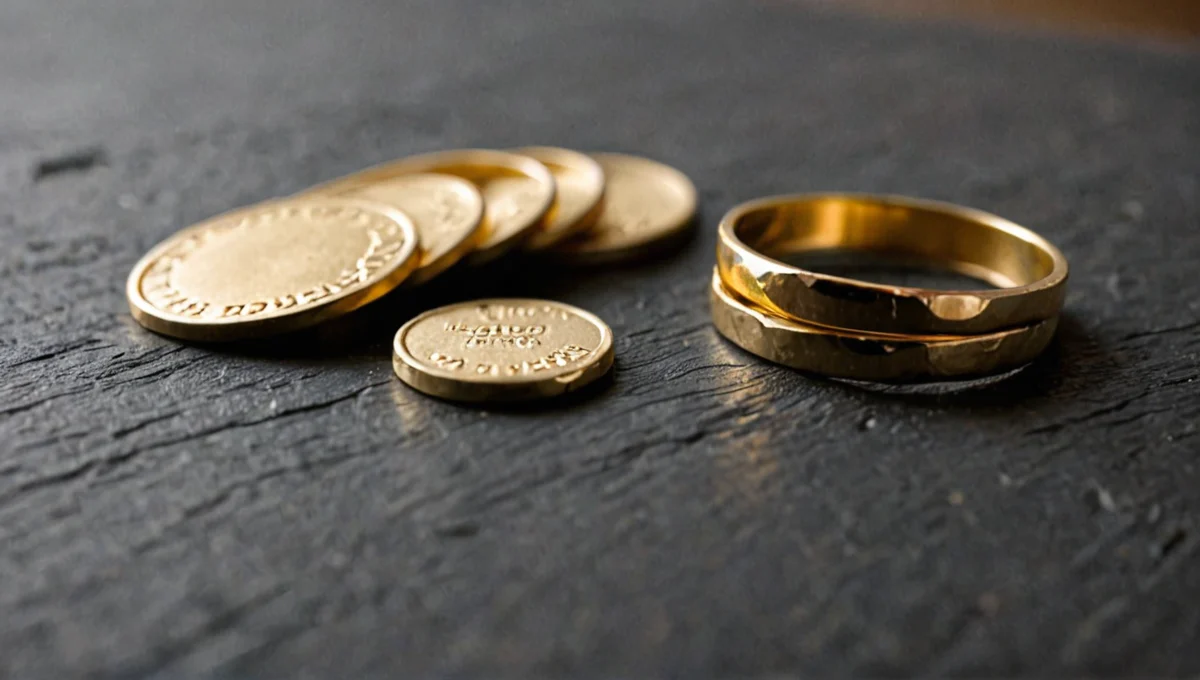
A bar, a coin and a finished piece are all gold, but they are not the same purchase. A bar is the closest thing to the London metal price, a coin carries a premium for its minting, and a finished piece carries a making charge for its design. What changes on the way in is the premium over the metal; what changes on the way out is the price a buyer can get back.
A bar is the closest to the metal price
A bar is the simplest form of gold: cast or minted, with a weight and a purity stamped on it. The making charge on a bar is small, because there is almost no fabrication, and the premium over the London metal price is the lowest of the three forms. A buyer who wants the most metal for the least money buys a bar.
On the way out, a bar is also the easiest to sell, because it is a standard weight and purity. A shop will buy a bar back at close to the metal price, less a small margin, and the buyer loses little on the round trip. That is why a bar is the honest unit for investment.
A coin carries a premium for its minting
A coin is a bar with a face: it is minted by a government or a private mint, and it carries a premium for that minting. The premium is higher than on a bar, because the coin is a collectible as well as a metal, and the premium varies with the coin. A well-known coin has a higher premium than an obscure one, and the premium is the cost of the coin's recognition.
On the way out, a coin is also easier to sell than a finished piece, because it is a standard weight and purity, but the premium may not be recovered. A buyer who pays a high premium for a coin may not get it back when selling, and the coin's value as a collectible is separate from its metal value.
A finished piece carries a making charge
A finished piece is jewellery: it has a design, a labour cost and a making charge. The making charge is the highest of the three forms, because the piece is the most fabricated, and the premium over the metal is the highest. A buyer who wants a finished piece is paying for the work, not just the metal.
On the way out, a finished piece is the hardest to sell, because it is not a standard weight or purity. A shop will buy it back at a discount to the metal price, and the making charge is lost entirely. The buyer pays for the design on the way in and does not get it back on the way out.
What a published price can and cannot show
A published price can show the suggested retail price per gram for each karat, and that is the same for all three forms. What it cannot show is the premium that each form carries: the bar's small premium, the coin's minting premium, and the finished piece's making charge. Those premiums are set by the seller, not by the trade body, and they are published nowhere.
The result is that a buyer who compares the three forms by the published price alone is comparing only the metal, not the total cost. The bar's total cost is closest to the metal price, the coin's is higher, and the finished piece's is the highest. That is the difference the published price cannot show.
The way in and the way out
The way in is the purchase: the total cost is the weight times the price per gram, plus the premium for the form. The way out is the sale: the price a buyer gets back is the metal price, less a margin, and the premium is not recovered. The difference between the way in and the way out is the cost of the form, and it is the reason a bar is the best form for investment.
A coin is a compromise: it has a lower premium than a finished piece, but a higher premium than a bar, and it is easier to sell than a finished piece. A finished piece is the worst form for investment, because the making charge is lost on the way out. That is the simple truth of buying gold in three forms.
Which form a buyer should choose
The choice of form depends on the buyer's purpose. A buyer who wants the most metal for the least money buys a bar. A buyer who wants a coin that is easy to sell buys a well-known coin. A buyer who wants a finished piece is buying jewellery, not investment, and should expect to lose the making charge on the way out.
The published price is the same for all three forms, but the total cost is not. A buyer who wants to know the total cost must ask for the premium itemised, and a buyer who wants to know the way out must ask what the shop pays on buy-back. Those are the questions that a published price cannot answer.
A bar and a coin hide different costs behind the same weight
A bar is the closest thing to raw metal on a Dubai shelf. The shop pays London for the gold, adds a thin margin for its own running costs, and strikes a price per gram that tracks the morning fix. There is little work in it, so there is little to charge for. A buyer who wants the most gold for the least dirhams is pointed here first.
A coin is not simply a bar with a face on it. Minting is a separate step, and the shop pays for that step when it buys the coin from a wholesaler. That premium is passed to the buyer, but it is not always shown as a separate line. A coin can weigh exactly the same as a bar and still cost more, because the work of striking it has already been paid.
What confuses buyers is that both forms are priced by weight at the counter. The shop quotes a gram rate or a tola rate, and the coin appears to sit at the same rate as the bar. In fact the coin's rate has been quietly lifted to recover the minting premium. A buyer who thinks all gold by weight is equal will miss the extra cost.
The way out of a coin is narrower than the way in
A bar is easy to sell back because the shop can see the metal and the stamp. The buy-back price is set from the London figure, and the shop will take the bar without asking where it came from. The spread between the shop's selling price and its buying price is the cost of liquidity, and on a bar that spread is among the narrowest in the market.
A coin carries a different risk on the way out. The shop must identify the coin, verify its condition, and sometimes check whether a particular issue is still in demand. That is extra work, and the shop will not pay for work it does not want. A coin that was expensive to buy because of its minting premium can be valued as little more than scrap when it is sold back.
The practical consequence is that a coin's premium is paid once and never recovered. The buyer pays for the minting on the way in, but the shop's buy-back price starts from the metal content and adds only what the coin's collectible value can support. In Dubai's high-turnover shops, that collectible value is often zero.
A finished piece moves the negotiation away from the metal
A finished piece is the only form where the buyer can argue about a number that is not tied to London. The metal content is fixed, and the shop's gram rate will not move far from the published rate. The making charge, however, is a number the shop sets itself. It can be cut, waived, or doubled depending on the buyer and the day.
Because the making charge is the flexible part of the bill, it becomes the focus of any negotiation. A buyer who asks for a lower making charge is not asking the shop to lose money on the gold. The shop can keep its full metal margin and still reduce the total. That is why the question is usually met with a counter-offer rather than a flat refusal.
What often goes unnoticed is that a heavy piece can carry a making charge that looks small as a percentage but is large in dirhams. A buyer who focuses on the metal rate and ignores the making charge can pay more for the work than for the gold itself. The shop prefers it that way, because the gold is a commodity and the work is not.
The karat you pick decides how much metal the shop must buy back later
A lower karat means less gold in the piece, but it also means a different buy-back calculation. When a shop buys back a piece, it tests the karat and pays only for the gold content. The rest of the alloy is worth nothing to the shop. A buyer who chooses eighteen karat over twenty-two karat has already decided how much gold can be recovered.
The shop's buy-back price is not based on what the buyer paid for the piece. It is based on the weight of pure gold that can be extracted. A lower karat piece therefore returns less dirhams at the same weight, even before the shop's own buy-back margin is applied. The metal that was never there cannot be sold back.
The mistake buyers make is to compare the buying price of two karats without thinking about the selling price. An eighteen karat piece costs less at the counter, but it also returns less at the buy-back counter. The gap between those two prices can be wider for a lower karat, because the shop's fixed costs are spread over less gold.
The three forms in brief
Next question
Questions about weight and price
What is the difference between a bar and a coin?
A bar is the simplest form, with a small premium over the metal price. A coin carries a higher premium for its minting, and the premium varies with the coin's recognition.
Why is a finished piece the most expensive?
A finished piece carries a making charge for the design and labour, which is the highest premium of the three forms. That charge is lost on the way out.
Can a published price show the premium?
No. A published price shows the suggested retail price per gram, which is the same for all three forms. The premium for each form is set by the seller and published nowhere.
Which form is easiest to sell?
A bar is the easiest to sell, because it is a standard weight and purity. A coin is also easy, but a finished piece is the hardest, because it is not standard.
Does the making charge come back on the way out?
No. The making charge is lost on the way out, because a shop buys back at a discount to the metal price. That is why a finished piece is not an investment.
A position on gold that never goes on a scale
An FxPro account deals in the price of gold rather than the metal: nothing is weighed, nothing is delivered and no making charge is added, because there is no piece to make. It is a different proposition from buying at a counter, and worth understanding as one before it is mistaken for the other.